

HSBC logo. (2019). Retrieved from https://www.hsbc.co.uk/
‘Go digital or Go home’, fast improving digital models enable companies to increase their efficiency and revenue under a sharing economy, on the other hand, for companies who couldn’t keep up in the line might get ‘send home’ no matter how successful they were in the past. A good example is the photography giant Kodak, which has failed to adapt this sharing economy and further led to its bankruptcy against its digitalized competitors like Apple and Nikon.
From traditional to digital
As a matter of fact, the connection in the digital world is not only about technology. Peter Weill suggested a four-dimensional approach of choosing a suitable digital business model. Peter’s model indicates that the organization should think from ‘omnichannel conduction’, ‘ecosystem driver’, ‘supplier expansion’ and ‘modular producer’ by setting a clear initial strategy and further applying appropriate digital methods to solve the challenges that arose from its strategy, instead of applying the most recent technology without a specific business drive. HSBC is one of the organizations which utilized this model to conduct their digital operations.

How HSBC reinvented its digital business model
As a leader in the world banking industry, HSBC has directed $2.3 billion on improving its artificial intelligence (AI) and digital capabilities around the globe in the past 2 years, as part of its effort to improve the experience of existing customers and attract more of the customer segments it is targeting for growth. Here are some approaches they have conducted:
- Build a mature contact center
You don’t want to visit a branch just with a question that can be answered in a minute or call up and wait to be answered forever (even though you could do other stuff while ringing, how many of us enjoy the constant beeping in the background?). To solve this ‘omnichannel’ challenge, HSBC has launched a 24/7 contact center in 2017 for people that need a general banking assistant. HSBC’s live Chatbot AiDA resulted in a $3.5 million annual cost saving (staff cost etc.) and provides more flexibility to clients as well as a more comfortable experience.
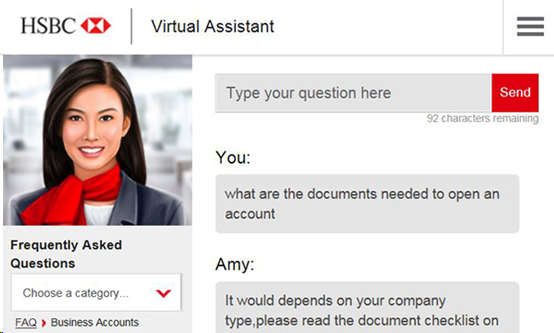
HSBC chatbot AiDA. (2019). Retrieved from https://thefinancialbrand.com/71251/chatbots-banking-trends-ai-cx/
- Develop an ‘ecosystem’ mobile app
HSBC worked with IBM and improved the HSBC app that gives users more authorization to trade financial products, which increases its potential margins. After upgrading the additional features in HSBC app, the download increased by 55% in 2017, and was up by 60% in terms of value payments. According to HSBC , there was a 333% increase in the number of mobile banking customers over the past 5 years.

HSBC Mobile Banking App. (2019). Retrieved from https://www.knowyourmobile.com/mobile-phones/apple-iphone-6/22699/uks-best-and-worst-banking-apps-iphone-2016
- Enhanced collaboration with tech giants
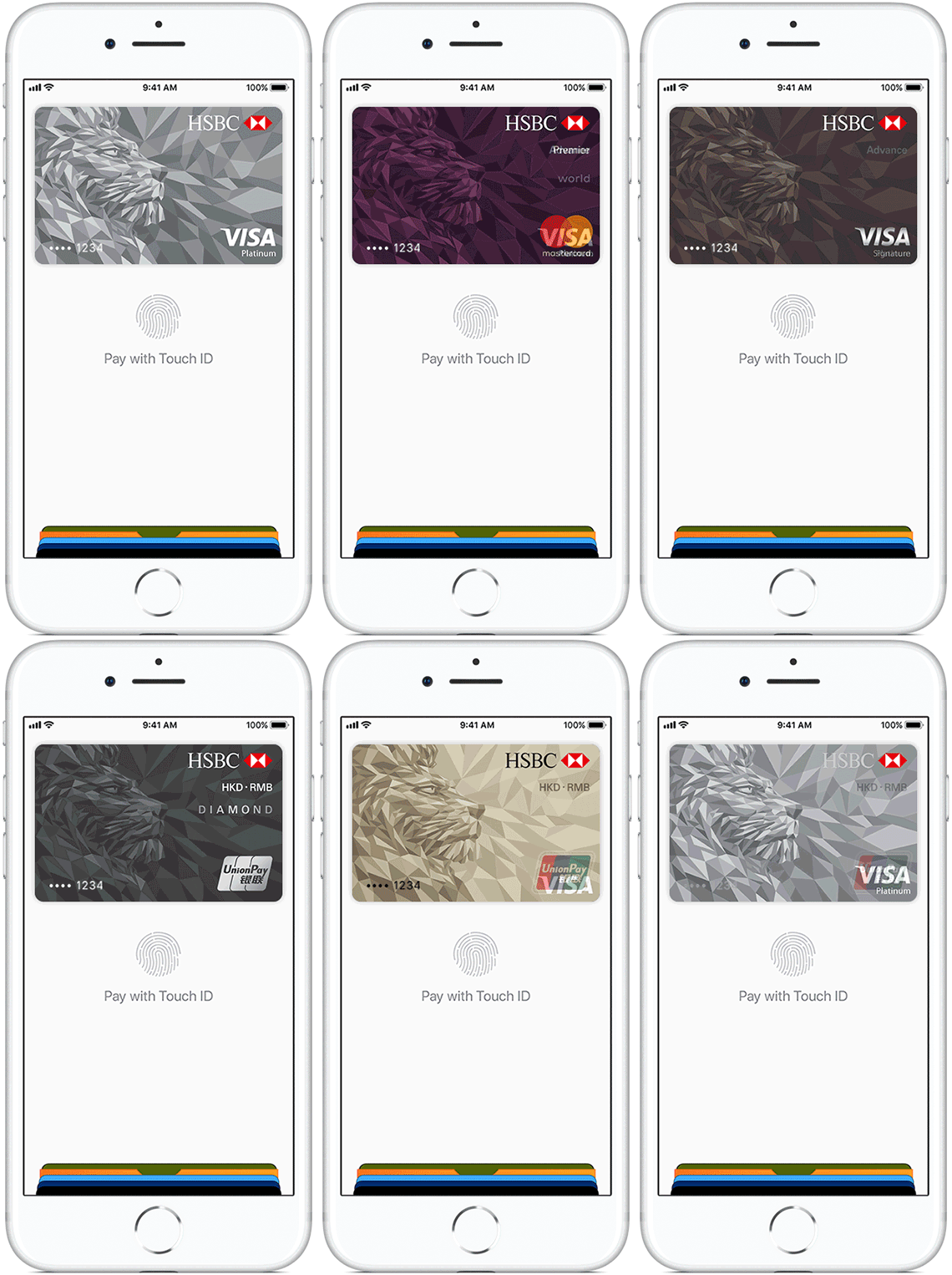
Apple Pay | Credit Card Payment Service – HSBC HK. (2019). Retrieved from https://www.hsbc.com.hk/credit-cards/products/payment-services/apple-pay/
With the rise in payment giants like Wechat Pay, which combines social media with mobile payment, our society is moving not only to cashless but ‘cardless’. The ‘modular producer’ dimension is getting more and more important.
In response to the above issue, HSBC began to collaborate with other Fintech companies and further launched the massively well-received Apple Pay and Android Pay services; and created a data lake that performs the analytics monitoring customer behavior for compliance purposes. By doing this, HSBC had an additional 1.5 million customers of its digital banking services globally. This further can be used to construct a better consumer profile, thus a better marketing strategy on its financial products.
- Upcoming future unmanned bank
HSBC’s new robot assistant ‘Pepper’ has recently launched in HSBC flagship Fifth Avenue branch in New York. ‘Pepper’ gives not only amusement in the queue, but also effectively solves customers’ query and improves their banking experience. With more ‘Peppers’ being applied in the future, branches front stuff cost can be reduced. As a matter of fact, the first unmanned bank has already launched in Shanghai last year with all unmanned counters and AI ‘staffs’.
Meet Pepper: HSBC’s new banking assistant robot. (2019). Retrieved from https://www.youtube.com/watch?v=norC0ekdoLQ
Tradeoffs of digitization
It is crucial for the organization to be aware of the drawbacks within its digital transition. HSBC has confirmed its information breach in 2018. The clients’ information leaked to public including user names and transaction details. Although HSBC has quickly managed to get back control by updating its system and minimized the damage, the lost in clients’ trust is not as easy as fixing the technology issues.
Compatibility is always another problem for digital models. With the increased urbanization and globalization, although more and more of us are getting used to the fast-moving technologies, there is still a huge proportion of our population that couldn’t access to internet. Thus, are these high-tech equipped models like unmanned bank really practical at the moment? Especially for a bank, where people keep most of their assets, upgrading it to be unmanned will be a completely different story compare to digitalized shops like Amazon Go. Therefore, how to efficiently apply the digital technologies is still a question for HSBC to consider.

Conclusion
Digital business models and the sharing economy have inevitably the potential to increase value of organizations. But the question is where and how to apply these models in order to make the best use of them. The organizations should also consider their company profile and strategy in order to apply the correct digital methods instead of chasing the latest digital technology without a clear future vision.
 Yuchen
That was an interesting read Chen. I especially appreciate your point about the amount of people that are still without internet. Seems to be about 50 % (https://en.wikipedia.org/wiki/Global_Internet_usage).
Similarly there are about 30 % of people that are unbanked (https://www.worldbank.org/en/news/press-release/2018/04/19/financial-inclusion-on-the-rise-but-gaps-remain-global-findex-database-shows). Do you think this also represents a risk or perhaps an opportunity to modern, digitized banks especially when you consider certain crytocurrency projects that aim to address these problems and represent potential competition?
https://www.newsbtc.com/2018/07/15/the-unbanked-population-cryptos-calling-card/
View at Medium.com
For example, one would only need a cheap smart phone to effectively do all of their money management in the future, on a block-chain.
Cheers,
Si
LikeLiked by 1 person
Hi Simon,
Thanks for your comment. For sure I think investing in cryptocurrency could be a method to address the problem you have mentioned, and in fact more and more people are getting in favour of cryptocurrency is because it overcame the difficulties like remittance (https://www.benzinga.com/pressreleases/18/12/g12915936/crypticcoin-cryp-key-advantages-and-ongoing-achievements-further-advan). However, I wouldn’t think this can work well at the moment within developing counties like Philippine, which mentioned in your article. ‘60% claimed to not have enough capital to fund a bank account, while 21% cited no reason, maybe indicating a lack of interest towards banking.’ (https://www.newsbtc.com/2018/07/15/the-unbanked-population-cryptos-calling-card/) The people would have less financial expertise therefore it would be a risk for them to spend their assets on vulnerable cryptocurrency market, a good example is the crash of Bitcoin. (https://www.thesun.co.uk/tech/6686173/bitcoin-price-crash-scam-cryptocurrency-dead-value-worth-high/)
Best wishes and hope to see you in workshop tomorrow 😉,
Chen
LikeLike
Hi Chen, just to clarify the crypto situation a bit. Not sure if you’re aware of this but there were similar news reports on Bitcoin crashing as far back as 2013 http://fortune.com/2017/09/18/bitcoin-crash-history/. It dropped $233 to $67—overnight! That’s a 71% drop. People claimed the bitcoin experiment had failed and was dead. But low and behold by 2014 it had managed to grow again to $1000. But another crash saw it fall to approx. $200, again many news outlets claimed it was dead. Many people lost a lot of money and committed suicide etc… after a few more growths and ‘crashes’ etc.. in 2018 it had managed to make it’s way up to $20,000 still before crashing again as reported in your reference from the Sun. Actually it has had multiple ‘crashes’ over this time. This is why a lot of people refer to them as ‘market cylces’. All markets go through cycles. I agree that a problem with crypto is that it is volatile. It moves quickly. But in fact this is something that can stabilize over time as all markets do.
Cheers
LikeLiked by 1 person
Very interesting Chen. Pepper seems like a fun addition, although I feel as though he/she (it?) is somewhat more of a marketing fad. I’m curious about the introduction of entirely AI staffed branches; obviously the reduced labour costs are of benefit however I don’t see what the incentive is for a customer to then visit a branch. Without the added value of speaking with a human, the physical branch is somewhat redundant as banks could offer the same services online. As competitiveness increases, with the emergence of many digital banks, do you think traditional high street banks such as HSBC should look to move away from bricks and mortar, or do you think there is potential for the AI staffed branch to thrive?
LikeLike
Thanks for your comment Ash! I compelety agree with you, there are things you mentioned that I haven’t thought about. To me, and I also mentioned in my blog, I really doubt for the practibility of this unmanned bank. Also you are right! If everything’s unmanned, why don’t people just do everything online instead?? I think the high street banks like HSBC should really put effort on investing online instead of physical branch, there are currently some news reporting the decline of Highstreet banks, also as you said, I don’t think people would be willing to go to the AI staffed banks if they can to everything online 🙂
LikeLike